

Beauty Dentist |The Goal of an Aesthetic Dentist: Leonardo Da Vinci’s Principle of Golden Proportion
Leonardo Da Vinci’s Principle of Golden Proportion
Leonardo Da Vinci’s Principle of Golden Proportion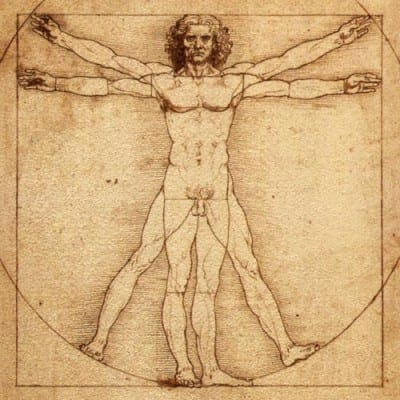 The Beauty Dentist: Dr. Anthony Mobasser uses Leonardo da Vinci’s principle of Golden or Divine Proportion with non-surgical cosmetic smile makeovers. Beautiful and enduring smiles are proportioned to harmonize with a person’s unique facial features to emphasize individual beauty.
Stained teeth can age our smiles, but a too-white smile can look out of place in the prime of life. Our teeth tend to get shorter with wear as we get older. Tooth lengthening is an effective solution for short or worn out teeth. Dr. Mobasser will guide you through golden proportions principle to achieve optimum cosmetics in dental restorations, veneers, and crowns, as well as improving facial proportions.
Laugh-lines and wrinkles can sometimes be ‘erased’ by using dental techniques to fill out these facial areas. Your smile will look totally natural.
How do we turn artistic inspiration into reality? A complete dental evaluation is necessary to measure the length to width ratio of each tooth, then their relationship to each other and then all your teeth as a whole in relation to your lips, and face to design your dream smile makeover. The position of the lips surrounding the teeth will determine the length and the black spaces between your cheeks and teeth can be filled up to give a more fuller smile, ( a zygomatic smile ) and hence a younger smile.
Of course there is a fine line as to how much lengthening of teeth is possible depending on the ratios of your roots to crowns, that is why an expert knowledgeable cosmetic dentist is required to treatment plan and design your smile makeover with the thought of health and longevity of how long your teeth with last if length is added to your teeth. A Beauty Dentist can answer questions such as: Can the roots of your teeth support the increase in length? All these answers will be addressed after a complete dental consultation!
The Beauty Dentist: Dr. Anthony Mobasser uses Leonardo da Vinci’s principle of Golden or Divine Proportion with non-surgical cosmetic smile makeovers. Beautiful and enduring smiles are proportioned to harmonize with a person’s unique facial features to emphasize individual beauty.
Stained teeth can age our smiles, but a too-white smile can look out of place in the prime of life. Our teeth tend to get shorter with wear as we get older. Tooth lengthening is an effective solution for short or worn out teeth. Dr. Mobasser will guide you through golden proportions principle to achieve optimum cosmetics in dental restorations, veneers, and crowns, as well as improving facial proportions.
Laugh-lines and wrinkles can sometimes be ‘erased’ by using dental techniques to fill out these facial areas. Your smile will look totally natural.
How do we turn artistic inspiration into reality? A complete dental evaluation is necessary to measure the length to width ratio of each tooth, then their relationship to each other and then all your teeth as a whole in relation to your lips, and face to design your dream smile makeover. The position of the lips surrounding the teeth will determine the length and the black spaces between your cheeks and teeth can be filled up to give a more fuller smile, ( a zygomatic smile ) and hence a younger smile.
Of course there is a fine line as to how much lengthening of teeth is possible depending on the ratios of your roots to crowns, that is why an expert knowledgeable cosmetic dentist is required to treatment plan and design your smile makeover with the thought of health and longevity of how long your teeth with last if length is added to your teeth. A Beauty Dentist can answer questions such as: Can the roots of your teeth support the increase in length? All these answers will be addressed after a complete dental consultation!

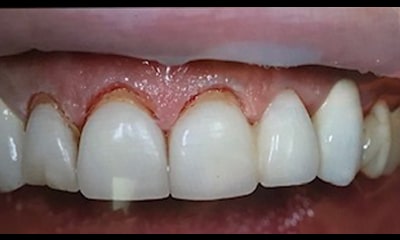
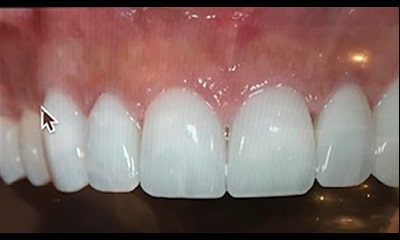
Treatment began with a detailed smile-design appointment. Dr. Mobasser developed the restorative plan, and a master ceramist created a diagnostic wax-up for the patient’s review and approval. Because the missing teeth were close to the sinuses, dental implant treatment would have required sinus lifts, bone grafting, and an extended healing period. She instead selected porcelain bridges for the missing teeth and veneers for the front teeth.
Da Vinci’s principles of aesthetics guided the smile design, establishing the appropriate length-to-width ratio for each tooth and an intertooth relationship of approximately 1.6/1/6. These proportions helped create balance, symmetry, and a natural progression across the smile. Zirconia was selected for its strength, brightness, and durability, while proper canine guidance was established to protect the restorations and support long-term function.
The task of a Beauty Dentist is to analyze whether your face perfectly proportioned. Tests include:
- Can a vertical line be drawn from a pupil to a corner of the mouth?
- Does your face divide horizontally into thirds?
- Does the lower third of your face divide into thirds (nose to chin)?
- Does your face divide vertically into fifths (5x width of one eye)?
- Is the length-to-width ratio of your front tooth 1.6 to 1?
- Is the lateral incisor 60 to 70% of the width of central incisor?
- Do you show at least 3 to 4mm of tooth display when your lips are at rest?
- Are the upper incisal edges of your teeth following your lower lip line?
- Does the shape of your teeth match your face? For instance, a longer ovoid face requires a more rectangular shaped tooth with an 80% width-to-length ratio.
- The length of teeth affects the aesthetic zone of Smile. Are your teeth too short or too long?
- For an aesthetically pleasing smile, the lateral incisors can be 1.0 mm to 2.0 mm shorter than the central incisors (front tooth), and the canine slightly shorter than the central incisor, and the proximity of incisal line (the edge of teeth) to lower lip at rest should be close to 4.0 mm.
- Per Dr. Mobasser, a fuller and brighter Smile can be achieved when all components of smile analysis are evaluated and designed to enhance not just the mouth but the overall appearance of the individual.